
The Philadelphia Inquirer on nursing and the world of STEM
A good April 2024 piece in the Inquirer highlighted the efforts of two local nursing professors to increase the U.S. government’s recognition of nursing as a STEM profession (science, technology, engineering, and mathematics). As the item noted, that matters because STEM fields are eligible for more funding and other benefits.
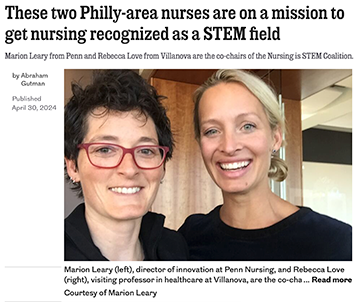
April 30, 2024 – Today the Philadelphia Inquirer published a helpful article about the efforts of two Philadelphia nursing professors to have nursing recognized by U.S. federal agencies as a STEM field (science, technology, engineering, and mathematics). Abraham Gutman’s piece focused on the newly formed Nursing is STEM Coalition, co-chaired by Marion Leary, of the University of Pennsylvania, and Rebecca Love, of Villanova University. As the piece explained, the STEM designation enables professionals to get access to significant grant funding and other important government benefits. The Coalition’s first major step was submitting a petition to the Department of Homeland Security (DHS) seeking that designation for nursing, which Leary and Love argued could influence other federal agencies. The piece posed several basic questions to the professors, and they explained key points. These included that nursing merits the STEM designation because everything nurses do is based on health science, and that the lagging recognition of the field’s true nature likely relates to gender bias. The article might have noted that wider recognition for nursing as a STEM field would not only have the immediate financial benefits it discussed, but would also increase broader social respect for the field, as we have long argued. That could in turn improve nurses’ access to greater resources in all settings, including clinical care and education. Of course, this piece itself served that broader educational purpose, and we thank those responsible.

No greater profession
The piece’s headline emphasized that the two nurses were “on a mission to get nursing recognized as a STEM field.” The introduction explained that the current lack of STEM recognition from most federal agencies limits nurses’ access to government grants and other funds, “like the [Biden] White House’s $1.2 billion investment in STEM in 2022.” In fact, that initiative, as stated in a December 2022 press release to which the Inquirer piece linked, has described the targeted fields as “STEMM”—with the second “m” referring to medicine. We also note that the “summit” at which the initiative was announced appears to have included the late Congresswoman Eddie Bernice Johnson, who was also a nurse. Even so, we doubt many of those involved, or who might be responsible for actually spending the funds, would see nursing as part of the “medicine” element—nor should they, as nursing is a distinct scientific field. In any case, the piece noted that only some agencies, like the Department of Veterans Affairs, currently recognize nursing as STEM. It said Leary and Love plan to submit the DHS petition at the end of April.
In addressing why the STEM designation matters, Leary and Love noted some other ways in which professions with that designation got “priority status” with governments and other institutions. For example, DHS permitted foreign students with STEM degrees to remain longer in the U.S. after graduation. Recently, DHS had been recognizing STEM fields beyond the traditional ones, including social psychology and global health. The piece also pointed out that at the time, there had been an emphasis by powerful institutions on encouraging more diversity in such fields. Love said that “STEM is basically building the careers of the future.” The item noted that Love also directs a nonprofit that looks for “ways to bill and reimburse for the care nurses provide.” The piece might have had more on this. We assume it is referring to the Commission for Nurse Reimbursement, which Love co-founded in 2023. That group seeks to “transform how nursing is valued and reimbursed” by “advocating for nursing care to be viewed as a billable service rather than an expense.” Reimbursement for hospital nursing is generally packaged together with room, board, and facilities charges, undermining any sense that nurses provide professional, life-saving services.

In response to a question about why nursing deserves the STEM designation, Leary explained that nurses apply the STEM disciplines in their daily work, and that they (in the piece’s words) “learn pharmacology, manage medications, and operate technology at the bedsides of patients every day.” The item also said that Leary and Love have heard about nurses who actually “had to return grants, or lost fellowship opportunities, because their degrees aren’t considered STEM.” We wonder how that worked – were grants initially provided partly on the basis of PhD status, but later in the process the grantor learned the PhD was in nursing and withdrew the grant? In any case, in this section the piece noted helpfully that Leary is Penn Nursing’s “director of innovation,” which sends the message that what she does involves intellect and rigor.
In addressing why nursing is not “universally recognized” as a STEM field, Leary said that she believes gender bias is a factor, noting that about 90% of nurses are women. She explained: “It’s a female-dominated profession living in a world of STEM that is majority male.”

Finally, in discussing their new STEM coalition, Leary and Love said that they saw recognition by DHS as a “bellwether,” since other agencies seemed to follow its lead on the STEM designation. They noted that their petition had been signed by more than 100 nursing organizations and leaders. A decision by DHS was reportedly expected in August 2024. Love said she hoped the STEM designation and resulting financial support would help sustain the profession after many nurses have left the bedside in the Covid era and (in the piece’s words) “many hospitals are struggling with a nursing shortage.” Of course, for the most part hospitals are struggling with a shortage of nurses willing to endure the understaffing and other poor conditions currently on offer, but that is probably beyond the scope of this piece. Wrapping up, the piece quoted Love: “There’s no greater profession in the United States, in my opinion, that uses a combination of science, technology, engineering, and mathematics to advance forward human health than nursing.”
See the article “These two Philly-area nurses are on a mission to get nursing recognized as a STEM field,” by Abraham Gutman, published in the Philadelphia Inquirer on April 30, 2024.
