
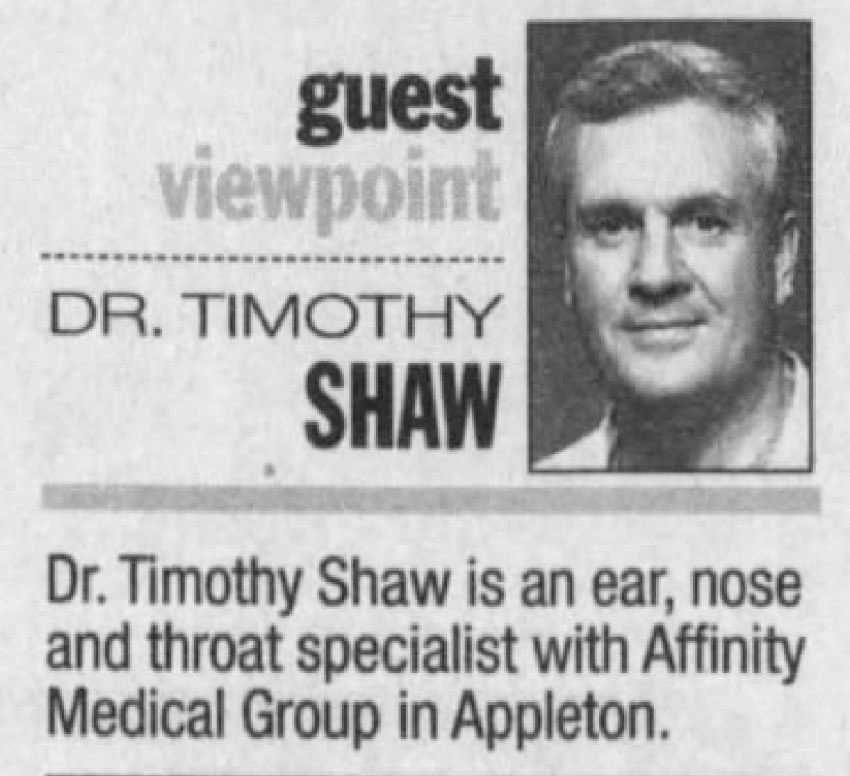
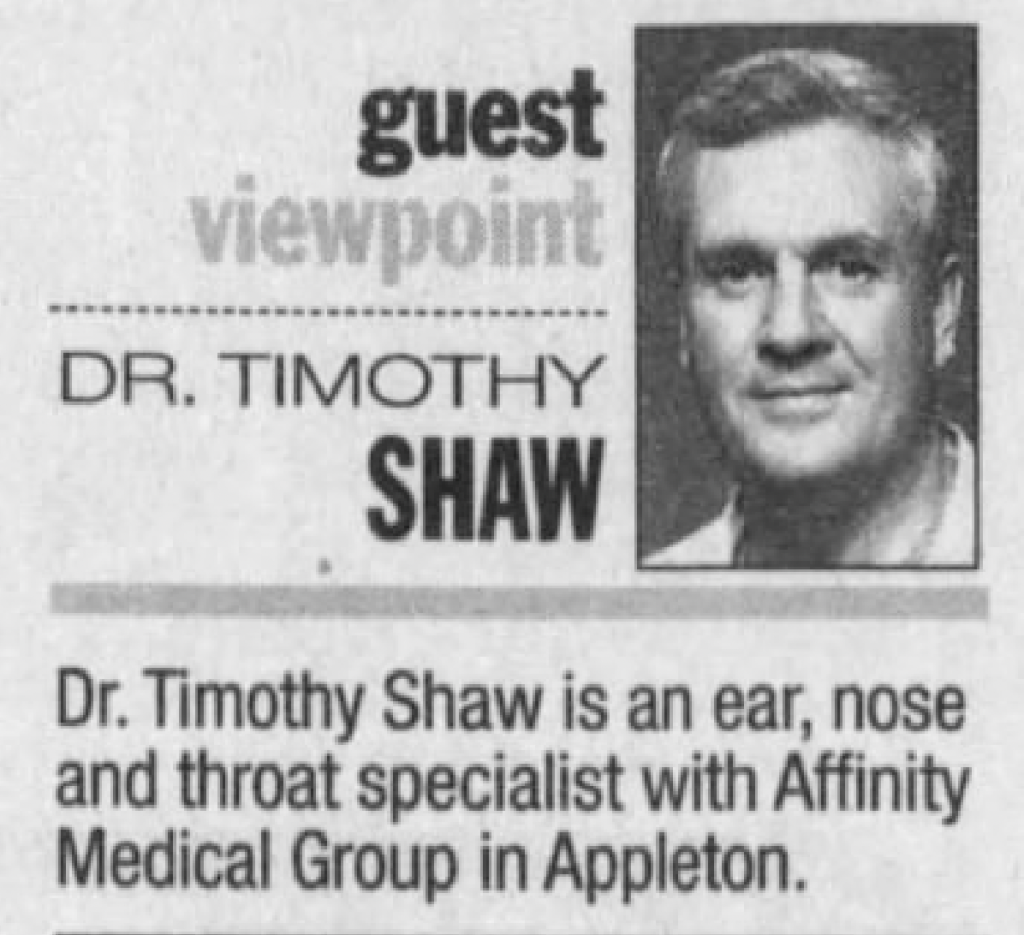
Timothy Shaw, MD, of Appleton, Wisconsin, wrote a great op-ed about nurses for Nurses Week 2003.
There’s never a bad time, even 23 years later, to highlight this Wisconsin physician’s astute, comprehensive, and moving tribute to the skilled, lifesaving care nurses provide.
May l0, 2003 ■ www.postcrescentcom Wisconsin
COMMENTARY
Nurses have difficult jobs that are invaluable
I have worked with nurses almost daily since 1972. It is with awe and amazement that I have come to realize what value they are to society and to each of us
One evening, I was called to perform a tracheostomy on a boy who had injured his neck, was paralyzed, and would not be able to come off the ventilator soon. I felt uneasy coming in the next morning to see him because I had sons about this boy’s age and felt terrible about the injury.
No sooner had I drawn back the curtain of his room when the nurse popped up from underneath the bed and smiled and said cheerfully, “Good morning, Doctor.”
She had just finished cleaning the boy’s “back-side” through a special trap door in his bed. She was totally nonplussed with this situation and was cheerful, talking to and caring for the boy.
She asked him to move his hand. The boy barely moved one tip of his finger. That was it – nothing else would move. The nurse was delighted and told him how great that was.
Although he was intubated and sedated, you could see a slight smile breaking at the corner of his mouth. As a doctor, reviewing the X-rays of the neck, I had my doubts that he would ever sit or walk again, but didn’t say anything so I wouldn’t squash the nurse’s or patient’s enthusiasm.
I have worked with nurses almost daily since 1972. It is with awe and amazement that I have come to realize what value they are to society and to each of us.
They work the delivery rooms, deliver babies, breathe the first breath of life into a baby, hold the elderly dying patient’s hand at their last hour, comfort grieving family members, attend funerals, make house calls to care for patients, change horrific wound dressings on badly burned patients, hold dangling near-amputated limbs until the surgeon can repair them, walk and feed patients, bathe them, and place IVs.
They work in emergency departments, intensive care units, surgery, “med-surg” wards and “psych” wards. They help run clinics, hospitals, and whole health systems.
They have the science knowledge of a college professor the math skills of a high school algebra teacher, the “cool-calm-collected” personality of a fighter jet pilot, the manual dexterity of a musician, the lifting capability of a bricklayer, the listening skills of a psychologist, the “Mr. Fix-it” skills of an auto mechanic, the interpersonal skills of an United States diplomat, and the love and caring of a parent. Roll all of this into one human being and you have yourself a nurse.
They are in perpetual motion – walking one patient to the bathroom, answering a few questions of the nurse’s aide, going off to “hang blood” on a leukemia patient with anemia, typing on the computer to order more supplies and order several laboratory tests on another patient, and calculating a “drip” rate on a patient with hypotension:
“Let’s see, I want a 2 microgram per kilogram per minute Dopamine drip at 10 cc’s per hour on a child who weighs 20 kilograms- 20 times 2 times 15 (1000cc/250/cc) divided by 10 cc per hour equals 60 – so if I put 60 milligrams of dopamine in 250 cc of 0.9 percent normal saline and set the drip rate at 10 cc per hour, I will deliver the correct drip dose rate.”
They put in a child’s IV while they’re screaming, comfort the poor mother whose child is getting the IV, then find time to ask a doctor making rounds, “Do you need any help with your patient?”
Then, they’ll help the doctor change a bandage, remove a drain and so on; take a two-minute lunch (if lucky), admit a new patient, discharge several other patients and coordinate all of their care and follow-up visits; run off to a “blue code” to help resuscitate a dying patient, then sit down for a one-minute break and thinking to themselves, “Wow, three hours down. Only nine more to go.”
When I was stationed at Womack Army Community Hospital at Fort Bragg several years ago, the deputy commander of the 82nd Airborne Division came to speak to our hospital.
The general was a lean, tough, combat-hardened soldier who related to us a story that has always stuck with me and epitomizes the profession of nursing.
When he was a young lieutenant stationed in Vietnam, he was told to evacuate a hospital that was under enemy attack by the North Vietnamese. He and his crew flew to the hospital to evacuate the staff and as many patients as they could handle.
All the patients were South Vietnamese, and the nurses were Filipino.
He gave the order that all the medical personnel must be evacuated, but given the tactical situation, they didn’t have enough helicopters or time to evacuate all of the South Vietnamese injured. He ordered the nurses aboard the helicopters.
All of them boarded the choppers except one nurse who refused to go. She said she would stay behind to continue to care for her injured patients. He remembers looking down at her small figure standing defiantly and proudly outside her makeshift wooden hospital, looking up at them as they took off.
Later that day, the hospital position was overrun and he learned that she had been murdered.
To finish the opening story, I was sitting in an Appleton restaurant one evening and in walked a handsome young man with a friend of his. I thought I recognized him but couldn’t quite place him, until I noticed a small tracheostomy scar on his neck.
Yup, it was him! He had totally recovered and was walking, healthy and happy. I think it’s true to say that his nurse’s care, hope, hands, mind and heart helped perform a miracle.
During this National Nurses Week, we should all show our appreciation to the women and men of the nursing profession who bravely and untiringly devote their lives to provide us with compassionate care and comfort.
My hat is off to nursing – the greatest profession.
Timothy Shaw is an ENT physician working in Appleton, Wisconsin
